Planning Material Handling Alongside Packaging
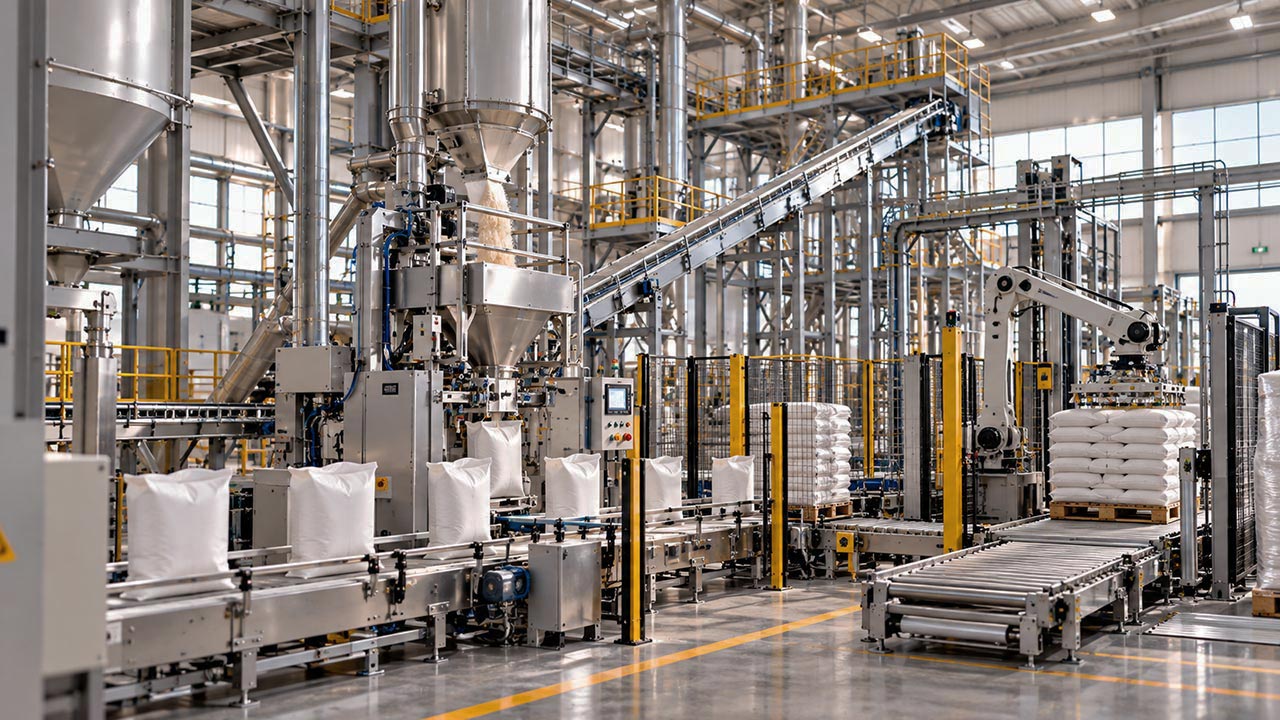
In a grain or flour facility, material handling and packaging are closely connected. Product must move from the process area to the packaging line, pass through weighing and bagging, and then be conveyed, palletized, wrapped, and prepared for dispatch where those stages are part of the operation. If these functions are planned separately, the interfaces between them can become sources of delay, extra handling, or difficult operating routines.
Follow the finished product journey
Map the route from the point where product becomes ready for packaging through to its final dispatch point. Identify transfer heights, distances, changes in direction, buffer locations, and the equipment that controls each stage. This reveals where the line depends on synchronized operation and where a pause in one stage can affect the rest. The map should reflect the actual facility layout and the package formats expected in production.
Match upstream supply with packaging demand
Packaging equipment needs a suitable and consistent supply of product, while downstream handling needs to accept the packaging line’s output. If either side is mismatched, equipment may wait or finished bags may accumulate. Capacity should therefore be evaluated across the connected sequence, including the practical effect of changeovers, planned stops, and operating patterns. Nominal machine ratings alone do not describe how the whole line will behave.
Consider people, access, and floor space
The layout should support safe movement, routine inspection, cleaning where required, and replacement of wear components. Space for pallets, wrapping, temporary accumulation, and dispatch activity should be considered along with the equipment footprint. Operator tasks and maintenance access are part of the system design because they affect how easily the line can be run and serviced in daily operation.
Coordinate equipment selection and controls
Conveyors, bagging machines, palletizers, and wrapping equipment need compatible physical and operational interfaces. The project review should clarify how product moves between stages and how the equipment responds when a downstream process pauses. Codema provides material handling solutions and packaging solutions that can be considered together according to the facility’s requirements. Related packaging technology from partners such as Italpack may also be relevant where it fits the application.
Conclusion
Material handling and packaging work best when the product journey is planned as one connected process. Reviewing flow, capacity, interfaces, layout, and maintenance access helps teams avoid designing each stage in isolation. Explore Codema’s material handling solutions, review Codema’s packaging solutions, and learn more about Italpack packaging technology as part of the wider packaging process.
