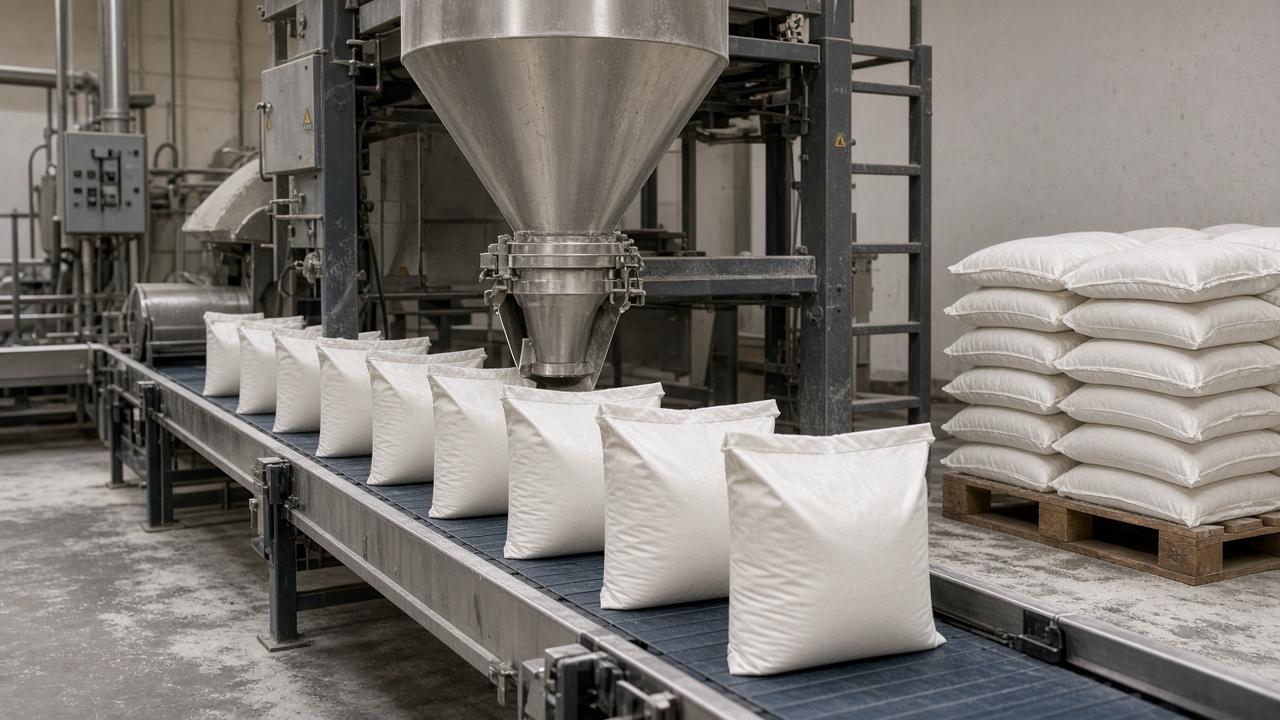
Improving Flour Mill Packaging Line Efficiency
Packaging is the final connection between production and dispatch. In a flour mill, a packaging line may include product feeding, weighing, bag filling, bag closing, conveying, palletizing, and stretch wrapping. If one stage cannot keep pace with the others, finished product may accumulate, operators may need to intervene frequently, and the overall line can become difficult to manage. Improving efficiency starts with understanding how these stages interact.
Find the actual bottleneck
Before changing equipment, observe the line during normal production. Look for waiting time between weighing and bagging, interruptions at bag placement or closing, accumulation on conveyors, and delays at palletizing or wrapping. Record the conditions under which interruptions occur, including product type, bag format, shift pattern, and changeovers. This makes it easier to distinguish a recurring equipment constraint from an issue caused by setup, material supply, or operating procedure.
Review the whole packaging sequence
A packaging line should be evaluated as one connected process. The output of the weighing system must match the bagging equipment’s operating requirements, while downstream conveyors and palletizing equipment must handle the actual discharge pattern. Product characteristics, target package formats, available floor space, and dispatch requirements also influence the configuration. An upgrade to one machine should not create a new constraint elsewhere in the line.
Make changeovers and access part of the design
Frequent product or bag-format changes can affect line availability. Clear setup procedures, suitable access for cleaning and inspection, and an arrangement that allows operators to work safely can make daily operation more manageable. The right approach depends on the products handled and the facility’s requirements. Equipment selection should account for the real production mix rather than an idealized single-product scenario.
Coordinate equipment and controls
Packaging equipment needs to exchange product and operational signals with upstream and downstream systems. When interfaces are poorly planned, operators may need to compensate manually for inconsistent flow or repeated stoppages. A coordinated engineering review considers product transfer, weighing and dosing, bagging, palletizing, and wrapping together. Codema’s packaging portfolio includes automatic and semi-automatic lines and related end-of-line equipment, with solutions selected according to product and facility needs.
Conclusion
A more efficient flour mill packaging line is not necessarily the line with the most automation. It is the line whose stages are properly matched, whose bottlenecks are understood, and whose layout supports reliable operation. Explore Codema’s packaging solutions, learn about Italpack packaging technology, or review Codema’s references to understand the company’s broader project context.
